
Quick Summary
Men in early recovery often find that quiet outdoor settings create more anxiety, not less, because their nervous systems have adapted to treat stillness as a potential threat. Wilderness therapy brings that reaction into the open, where it can be addressed with clinical support instead of avoided. The stress response you feel on a trail or beside a fire does not mean something is wrong. It reflects a nervous system adjusting after months or years of running on cortisol, substances, and constant distraction.
- Chronic substance use trains the nervous system to treat hyperarousal as its baseline normal state
- Wilderness therapy pairs physical challenge with clinical processing to rebuild stress tolerance gradually
- Feeling restless or uneasy in calm settings is a predictable early-recovery response, not a personal failing
- Structured outdoor programming gives men a concrete way to practice sitting with discomfort before returning to daily life
How Substance Use Rewires Your Stress Response System
If you have spent a long stretch managing stress with alcohol, stimulants, opioids, or constant motion, your body has adapted in ways that are not always obvious at first. Over time, it learns to operate at a higher level of tension, where cortisol stays elevated, sleep becomes lighter, and unstructured time starts to feel uncomfortable instead of restorative.
Then you find yourself in the hills outside Vista with no phone signal and nothing scheduled for a couple of hours, and your body reacts before you can think it through. Your chest tightens, your mood shifts, and your attention moves toward anything that feels like a problem to solve, because staying still starts to feel like something you need to get out of.
What you are feeling comes from a stress system that has been conditioned to stay active for long periods of time. The National Institute on Drug Abuse has documented how prolonged substance use reshapes the brain’s stress circuits, leaving the body in a heightened state of alert even after substances are removed. At Sacred Journey Recovery, wilderness therapy is used to bring that response into the open so it can be understood and worked through with clinical support instead of avoided.
Why Wilderness Therapy Is Effective for Stress and Mental Health
Traditional therapy often takes place indoors, seated, in a controlled environment. That structure works for many situations, but it can feel restrictive for men who have spent years staying in motion or avoiding stillness altogether. When the environment becomes quiet and contained, the focus shifts inward quickly, and that can bring up tension that feels difficult to manage in the moment.
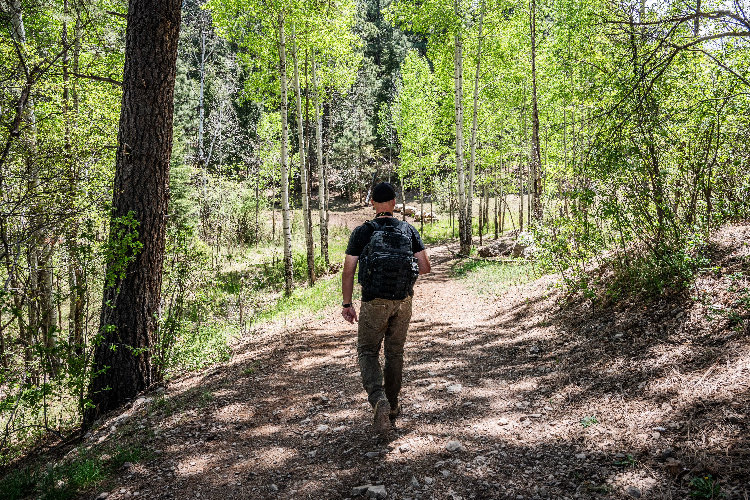
Understanding how wilderness therapy works for adults in recovery change how that experience unfolds. Walking in outdoor settings helps regulate the nervous system while keeping the body engaged, and uneven terrain requires enough attention to interrupt spiraling thoughts without overwhelming your attention. Research published in the Proceedings of the National Academy of Sciences found that people who walked in natural environments showed reduced activity in the subgenual prefrontal cortex, a region linked to repetitive negative thinking.
At Sacred Journey Recovery, these outdoor experiences are paired with experiential therapy so the reactions that show up during a hike, a quiet stretch of trail, or a group task can be observed and worked into treatment in a direct way. Counselors pay attention to how you respond when the pace slows, when the group gets quiet, or when a task requires patience, and that information helps guide the clinical work that follows.
Why Calm Feels Uncomfortable in Early Addiction Recovery
In the early stages of wilderness sessions, most men feel steady during the active parts. Hiking, setting up a site, and working with your hands give your body something familiar to lock into, so the tension stays manageable. The shift tends to happen when the pace slows or the structure drops away, especially when you are asked to sit quietly or spend time alone without a task to focus on.
That is when the internal response starts to surface. You might notice a low level of panic, a sudden wave of exhaustion, or irritation that does not seem tied to anything specific. These reactions come from a stress system that has been used to staying active, where the absence of stimulation feels unfamiliar and difficult to settle into.
Recovery involves helping your body adjust to a different baseline over time through repeated, supported exposure to stillness, quiet, and a lack of constant input. As those experiences build, your system begins to recognize that it does not need to stay on alert, and the intensity of those reactions starts to ease in a more consistent way.
How Stress Tolerance Rebuilds During Addiction Recovery
In the first week, most men notice a steady level of restlessness during unstructured outdoor time. It can feel like your system is looking for something to grab onto, whether that is a task, a distraction, or a reason to move. Some describe it as feeling exposed, while others notice a strong urge to get back into a more controlled environment.
By week two or three, a shift often begins to show up in a small but noticeable way. The agitation still comes, but it no longer feels constant, and it does not always require you to act on it. You may find yourself sitting through the discomfort and noticing that it rises and falls on its own, which reflects your nervous system starting to regulate more effectively.
By week four and beyond, the experience continues to change in a more subtle way. You might realize that several minutes have passed while sitting quietly without feeling the need to interrupt it or escape it. The environment starts to feel more neutral, and your attention becomes less tied to managing internal tension.
This kind of gradual shift is part of what makes structured treatment programs effective. The progress comes from repeated exposure and consistent support, allowing your system to adjust over time instead of relying on a single moment or breakthrough to carry the process forward.
How Wilderness Therapy Integrates With Addiction Treatment Programs
Experiences in outdoor settings often reflect the same patterns that show up in other areas of your life, and understanding whether wilderness reset programs for young men actually produce lasting change helps clarify why those patterns become part of the clinical work. The way you respond during a group task, a quiet stretch of trail, or a moment without structure can point to habits that carry into daily situations. If you notice that you become controlling when things feel unstructured, or that physical effort is the only way you can settle down, those reactions are addressed through structured therapeutic approaches so you can build a broader and more reliable set of tools.
Adventure therapy adds another layer by introducing challenge-based experiences that require trust, communication, and the ability to tolerate uncertainty. The specific wilderness therapy activities used in treatment such as rock climbing, ropes courses, and team navigation create immediate feedback through your physical response. You can see in real time how your body reacts under pressure, which gives the clinical team something concrete to work with rather than relying only on discussion.
At Sacred Journey Recovery, trauma-informed care means these experiences are adjusted to match where you are, not where you think you should be. If sitting alone by a creek triggers a strong response, that reaction is worked through at a pace that supports progress instead of pushing you past your limits. The process is designed to build awareness and control in a way that carries into daily life, so the progress you make outdoors continues to hold up when you return to your normal environment.
Why Simply Trying to Relax Does Not Replace Proper Recovery
Men in recovery often hear general advice about calming down or finding a way to settle their mind, and it can sound simple on the surface. In practice, it tends to fall flat because your nervous system is still operating in a constant state of alert, and trying to force a relaxed state often leads to more frustration instead of relief.
A more effective approach comes from giving your body consistent exposure to environments where it can begin to settle on its own. Wilderness settings create that opportunity by lowering external pressure while still keeping you engaged enough to stay grounded.
Over time, your system starts to recognize that it does not need to stay on edge, and that shift happens through repeated experience rather than instruction. A SAMHSA advisory on substance use treatment supports this approach, noting that experiential and body-based interventions can help engage people who do not respond to traditional talk-based methods.
Men who make progress in this process usually stop trying to control how they feel and start paying closer attention to what is happening in their body. That awareness becomes more consistent with practice, and it gives you a way to respond differently instead of falling back into the same patterns that kept your system activated.
Build Real Stress Tolerance With Sacred Journey Recovery
Southern California’s climate and terrain make year-round outdoor programming possible, which matters when your nervous system needs consistent exposure over time instead of relying on a single reset. At Sacred Journey Recovery’s Vista location, that consistency is built into the structure of treatment so men can work through stress responses in a way that actually carries over into daily life.
You can verify your insurance coverage with us and reach out to the team at Sacred Journey Recovery to talk through what treatment could look like for you. The conversation stays private, and it gives you a clear starting point if stress still feels easier to handle than stillness. Learning how to sit in calm without needing to escape it takes practice, and it becomes more natural with the right structure and support.
Sources
National Institute on Drug Abuse. “Drugs, Brains, and Behavior: The Science of Addiction.” NIDA, updated 2024.
Bratman, G.N., et al. “Nature experience reduces rumination and subgenual prefrontal cortex activation.” PNAS, 2015.
Substance Abuse and Mental Health Services Administration. “Tips for Treating Substance Use Disorders.” SAMHSA.